
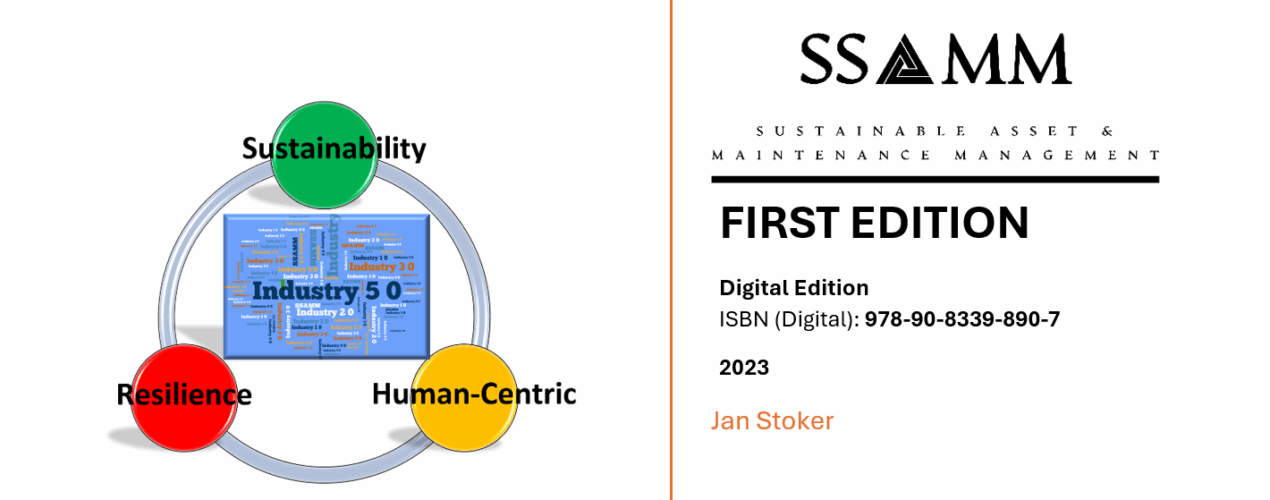
Colofon
Title: Sustainable Asset & Maintenance Management, First Edition, 2023 (Digital)
Author: Benjamin Stoker
Publisher: SSAMM (Click Here)
Publication platform: SSAMM Academy – ssammeducation.com
ISBN/EAN: 978-90-8339-890-7
Written by
Ing. Jan Stoker MSc. MEng.
Title: © B. Stoker – Sustainable Asset & Maintenance Management
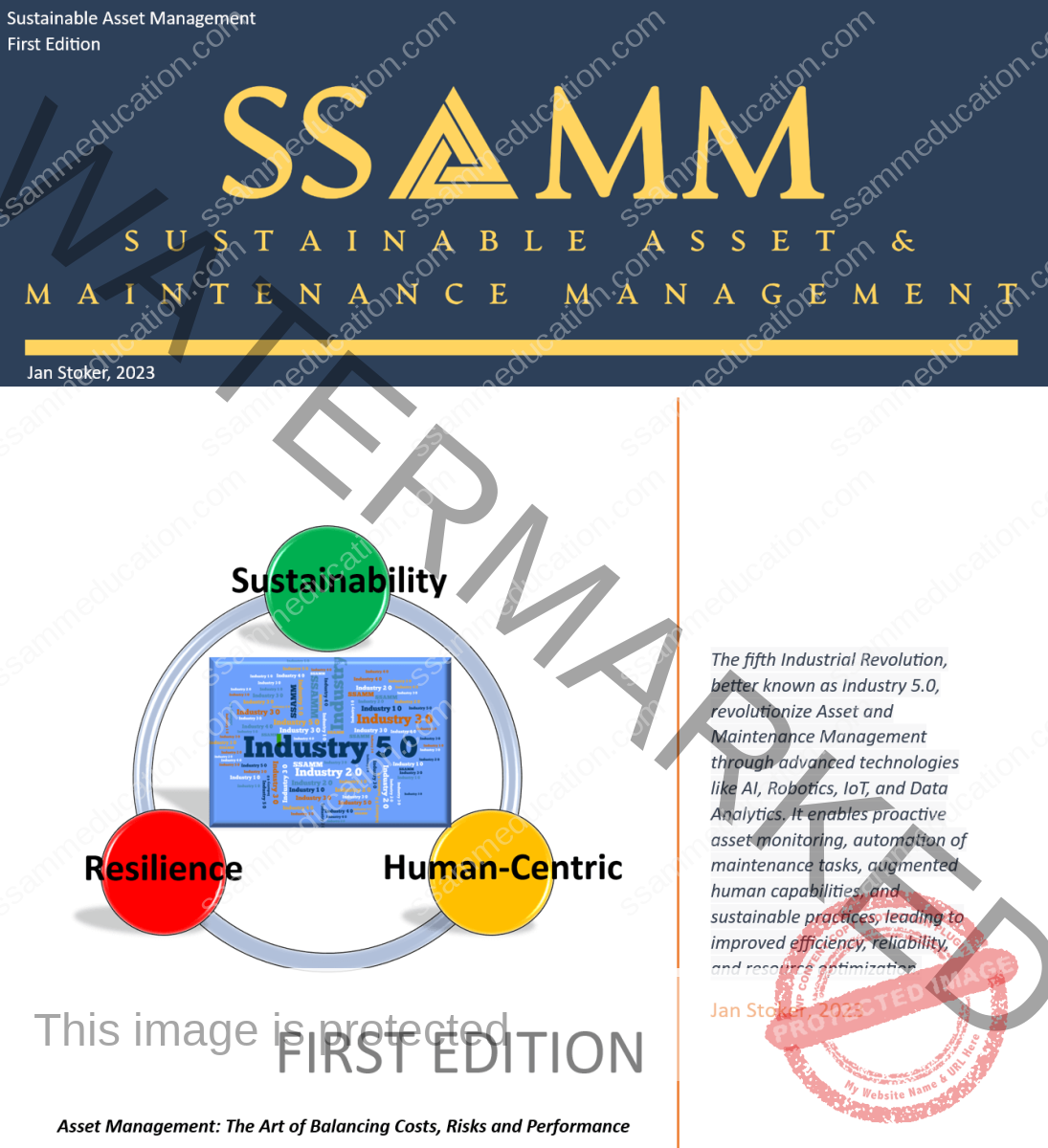
Front cover image: © B. Stoker
Book design: © B. Stoker
Phrase: © B. Stoker – Asset Management: The art of Balancing Costs, Risks and Performance
Publication Data / Imprint
Digital Edition
ISBN (Digital): 978-90-8339-890-7
First Edition, 2023
First digital printing, 2023
Printed and published by:
SSAMM
Planetenbaan 653
3721 KV Bilthoven
Utrecht, The Netherlands
Publisher websites:
https://www.ssamm.nl
https://www.ssammeducation.com
https://www.maincontract.nl
This digital publication is issued as a stand-alone work under ISBN 978-90-83398907 and functions as the reference edition for the online, continuously updated SAMM book hosted on https://www.ssammeducation.com.
All metadata relating to this ISBN (title, author, edition, publisher, year and format) apply to this digital edition

Copyright and Legal Notice
Copyright © B. Stoker
All rights reserved. No part of this publication may be reproduced, distributed or transmitted in any form or by any means, including photocopying, recording or other electronic or mechanical methods, without the prior written permission of the publisher, except in the case of brief quotations embodied in critical reviews and certain other non-commercial uses permitted by copyright law.
For permission requests, write to the publisher at the address below, addressed “Attention: Permissions Coordinator”:
SSAMM
Utrecht, The Netherlands
https://www.ssamm.nl
Any references to historical events, real people or real places are used descriptively. Examples, cases and situations are illustrative and do not describe specific organizations unless explicitly stated. All trademarks, trade names and product names used in this publication are the property of their respective owners; their use does not imply any affiliation with or endorsement by them.
The author and publisher have made every effort to ensure that the information contained in this publication is accurate at the time of publication. However, standards, regulations, technologies and practices evolve over time. This publication is provided on an “as-is” basis without warranties of any kind, either express or implied. The author and publisher shall not be liable for any loss or damage arising from the use of this material. Readers remain responsible for verifying current versions of standards and for applying professional judgement in their specific context.
Links to websites and online content are provided for the convenience of the reader. The author and publisher have no responsibility for the content of external websites and cannot guarantee the persistence or availability of URLs over time.
How to Cite This Publication
For academic, professional or educational use, the recommended citation format is:
Stoker, J. (2023). SAMM – Sustainable Asset & Maintenance Management. First digital edition. Bilthoven: SSAMM. ISBN 978-90-8339-890-7.
When citing specific online chapters of the SAMM book, please combine the reference to this publication with the chapter title, URL and access date, for example:
Stoker, J. (2023). The A&MM Lemniscate. In SAMM – Sustainable Asset & Maintenance Management (digital ed.). Retrieved from https://www.ssammeducation.com/the-amm-lemniscate/ (accessed DD Month YYYY).
About the Author
Through the SSAMM platforms and the SSAMM Academy, he shares this work with a global community of practitioners, students and organizations seeking to strengthen their Asset & Maintenance Management capabilities in a structured, standard-based and future-oriented way.

https://www.ssammeducation.com/news-publications/
Or consult the SSAMM Framework
Websites
Linkedin Pages
- SSAMM
- SSAMM Academy
- Sustainable Asset Management
- The Asset Manager
- The Maintenance Manager
- The Maintenance Engineer
- The Reliability Engineer
- Maintainability
- Industry 5.0
- A&MM 5.0 Implementation
- Circulair Asset Management
Social Media
This digital publication, SAMM – Sustainable Asset & Maintenance Management, was born from practice. Over the past years, the field of Asset & Maintenance Management has matured rapidly. International and European standards such as ISO 55000 and CEN/TC 319 have provided a strong normative backbone. At the same time, digitalization, Industry 5.0 and new expectations around sustainability and resilience have fundamentally changed the context in which assets are planned, operated and maintained.
In this environment, many organizations face the same questions:
How do we translate standards into a workable Asset Management System?
How do we connect Asset Management and Maintenance into one coherent value chain?
How do we embed digital tools and data-driven methods without losing line of sight to value, risk and people?
The SAMM concept answers these questions by combining:
- a clear normative basis in the latest ISO 55000 and the latest CEN/TC 319 standards;
- a set of integrating models – the Asset Management BowTie, the A&MM Lemniscate, the P–C–R Trefoil Balance and the Value Chain Standardization Line of Sight;
- and a dynamic, online book structure that can grow over time, supported by the SSAMM Academy.
This first digital edition is not meant as a final word. It is a stable reference point and an invitation to read, to explore the online chapters, to apply the concepts in your own context and to contribute to the ongoing development of Sustainable Asset & Maintenance Management. As the online SAMM book evolves with new insights, standards and examples, this publication will remain the anchor, while the digital content around it is continuously reviewed, enriched and updated as a living body of knowledge.
Bilthoven, 2023
Ing. Jan Stoker MSc. MEng. AMCP. CFAM.
Abstract
- international and European standards such as the ISO 55000 series and the CEN/TC 319 maintenance standards;
- an integrated set of conceptual models – including the Asset Management BowTie, the A&MM Lemniscate, the Performance–Cost–Risk (P–C–R) Trefoil Balance and the Value Chain Standardization Line of Sight (VCS Line of Sight);
- and a modular, continuously updated online book and learning environment hosted on the SSAMM Education platform and used within the SSAMM Academy.
The publication explains how Asset Management and Maintenance Management have evolved through the industrial revolutions towards Industry 5.0, and how digitalization, artificial intelligence and data-driven decision-making can be embedded in a rigorous Asset Management System (AMS). It clarifies that the normative foundation is explicitly anchored in the latest editions of the ISO 55000 series and the current CEN/TC 319 standards, which together provide the backbone for terminology, processes, roles, competence and governance.
The intended audience is broad: executives, asset managers, maintenance managers, engineers, reliability specialists, students and professionals from other disciplines who interact with asset-intensive systems. The language is deliberately accessible, without losing conceptual and normative depth.
The publication can be read as a stand-alone introduction, as a high-level map of the online SAMM book, and as a reference text for the SSAMM Academy learning paths.
1. Purpose and Scope of This Publication
The purpose of this publication is threefold.
- To provide a coherent narrative that explains what is meant by Sustainable Asset & Maintenance Management in the context of modern standards, digitalization and Industry 5.0.
- To act as an ISBN-registered, citable entry point into a dynamic, continuously evolving online book hosted on SSAMM Education (https://ssammeducation.com), where all detailed chapters are maintained, periodically reviewed and extended.
- To serve as a foundational text for the SSAMM Academy, where the same concepts are used as the backbone for training, lectures and professional development in Asset & Maintenance Management.
Where a traditional book freezes content at the moment of printing, the SAMM concept deliberately separates the stable reference layer (this PDF, with ISBN) from the living content layer (the online chapters and publications). New insights, updated standards and case studies can be incorporated online without invalidating the core structure presented here, so that the SAMM book functions as a continuously updated, living body of knowledge.
This publication therefore does not reproduce every chapter in full. Instead, it:
- sketches the overall architecture of the SAMM book and its online table of contents;
- explains the normative backbone: ISO 55000 and CEN/TC 319;
- introduces the central conceptual models developed and used by the author;
- clarifies how these models are applied in the SSAMM Academy modules; and
- invites the reader to explore specific chapters online according to their own learning needs.
Throughout, the perspective is both practical and didactic: the text is written to be understandable for readers from different educational backgrounds, while remaining rigorous enough to support professional and academic application.
The notion of a dynamic book is central to SAMM. This PDF forms the stable, citable core: it sets out the overall architecture, key concepts and normative foundations of Sustainable Asset & Maintenance Management. Around this core sits the online SAMM book on SSAMM Education, where each chapter can be updated, extended or newly added as standards, practices and technologies evolve. In this sense, the present publication functions as a hub rather than a closed volume. It provides the reader with a structured overview and line of sight, and then points towards the living web chapters in which the subjects are treated in greater depth. The following sections explain how this dynamic structure has grown out of the historical development from the industrial revolutions to Industry 5.0, and how the online SAMM book is organised as a continuously evolving body of knowledge. The story of Asset & Maintenance Management is inseparable from the story of the industrial revolutions. The online chapter The Industrial Revolutions traces the path from: Across these revolutions, the nature of assets has changed – from visible mechanical machines to complex infrastructures, software-intensive systems and interconnected networks. Correspondingly, Maintenance Management has moved from “fixing breakdowns” to risk-informed, data-driven and standardised practice. SAMM situates itself explicitly in Industry 5.0. Digital twins, IoT, AI and advanced analytics are recognised as powerful enablers, but they are always framed within a management system and a standardised value chain. Technology is not a goal in itself: it is there to support better decisions on performance, cost and risk, and to strengthen human judgement rather than replace it. 2.2 A Living, Web-Based Book The online SAMM book is structured as a set of web chapters, accessible via a central table of contents (Click Here). At the time of this first digital edition, the core sequence includes, amongst others: This list will not remain static. New chapters can be added, existing chapters can be expanded or reframed as standards evolve (for example, with new editions of ISO 55000 or additional CEN/TC 319 standards), and fresh case material can be integrated over time. This PDF, however, remains the reference lens: it explains how these chapters fit together into one overall Sustainable Asset & Maintenance Management narrative.2. A Dynamic Book in an Industry 5.0 Context
2.1 From Industrial Revolutions to Industry 5.0
3. Normative Foundations: ISO 55000 and CEN/TC 319
In Sustainable Asset & Maintenance Management, standards are not treated as an appendix but as the structural spine of the entire narrative. This publication therefore introduces the normative foundations at a high level, while the online SAMM chapters provide the detailed interpretations, mappings and use cases. As ISO 55000 and the CEN/TC 319 maintenance standards evolve, their latest editions and implications are first reflected and elaborated online; this PDF remains the stable frame that explains why these standards matter and how they fit together.
In that sense, this chapter functions as a hub for all standard-related content in the SAMM book. It outlines the role of the ISO 55000 series for Asset Management, the role of CEN/TC 319 for Maintenance Management, and the way in which SAMM combines them into one coherent architecture. The following sections briefly summarise these foundations and point the reader towards the corresponding online chapters, where the standards are discussed in greater depth and updated as new versions appear.
3.1 Standards as the Backbone
The conceptual and practical content of SAMM is firmly grounded in established literature, but its normative backbone consists of:
- the ISO 55000 series for Asset Management; and
- the CEN/TC 319 maintenance standards for Maintenance Management.
The ISO 55000 family defines:
- a common vocabulary, principles and overview (ISO 55000);
- the requirements for an Asset Management System (AMS) (ISO 55001);
- guidance on applying these requirements (ISO 55002); and
- specific guidance for finance alignment, public policy, people and data (ISO/TS 55010, ISO 55011, ISO 55012, ISO 55013).
CEN/TC 319 provides the complementary maintenance perspective, including:
- EN 13306 (maintenance terminology) and EN 17007 (maintenance processes and indicators) as a common basis;
- standards such as EN 16646, EN 17485, EN 17948, EN 15331 for maintenance management and value across the life cycle;
- standards such as EN 17666, EN 15341, EN 16991, EN 17840, CEN/TS 17385, EN 17975 for maintenance engineering, KPIs and risk-based methodologies;
- and standards such as EN 13269, EN 13460, EN 15628 for contracts, documentation and qualification of personnel.
In SAMM, these standards are not treated as a list of external references, but as a designed architecture. They define language, processes, roles and capabilities. The online chapters interpret their intent and demonstrate how they can be combined into one coherent Asset & Maintenance Management system.
3.2 ISO 55000 and the Evolution of Asset Management
The online chapter The Evolution of Asset Management traces the journey from PAS 55 to the current ISO 55000 series. It shows how the field has matured from fragmented practice to a recognised management system discipline. PAS 55 codified early leading practice; ISO 55000 expanded this into a global standard; and the latest editions broadened the scope to finance, public policy, people and data.
In SAMM, ISO 55000 is understood as more than a compliance checklist. It is a way of thinking about value: value for the organisation, for stakeholders and for society. It connects strategy and governance with life-cycle decisions and day-to-day activities on assets.
3.3 CEN/TC 319 and the Evolution of Maintenance Management
The online chapter The Evolution of Maintenance Management follows a similar arc but from the maintenance perspective. It describes how Maintenance Management has moved:
- from breakdown repair to preventive maintenance;
- from time-based to condition-based and risk-based maintenance;
- from an isolated cost centre to an integrated value and risk management function, supported by standards.
- and, in the context of Industry 5.0, towards a Maintenance 5.0 perspective, where human-centricity, resilience, sustainability and advanced digital technologies are combined in one coherent approach.
CEN/TC 319 standards provide the common language, process models, methodologies and competence frameworks that modern Maintenance Management – including Maintenance 5.0 – relies on. They underpin the transition from ad-hoc, tool-driven initiatives to a structured, standard-based maintenance system that can integrate AI, digital twins and data analytics without losing sight of people, safety and long-term value.
In SAMM, these standards are woven into a narrative that shows maintenance as an equal half of the Asset Management discipline, fully integrated with the ISO 55000 framework. The Maintenance 5.0 perspective is therefore not presented as something separate from standards, but as an evolution that builds directly on the CEN/TC 319 foundation and aligns with the broader Asset & Maintenance Management value chain.
4. Key Conceptual Models in SAMM
To make the standards and the value chain visible, SAMM uses a set of recurring visual and conceptual models. These are not separate “theories”, but integrating devices that connect standards, governance and practice.
4.1 The Asset Management BowTie
The Asset Management BowTie (AM-BowTie) links risk logic and value creation. On the left side, the ISO 55000-based Asset Management System sets purpose, objectives, strategies and plans. On the right side, the CEN/TC 319-based Maintenance System organises processes, methods and resources. In the centre, the bowtie structure shows:
- causes and threats;
- preventive and mitigating barriers;
- consequences and impacts.
The AM-BowTie thus acts as a bridge between strategic intent and operational control. It demonstrates that risk management is not an add-on, but embedded in how assets are planned, operated and maintained. The corresponding online chapter and deepening article explain the model in detail and connect it to standards such as EN 17485, EN 16646 and EN 17666.
4.2 The A&MM Lemniscate and Lines of Sight
The A&MM Lemniscate uses the ∞ symbol to represent the continuous loop between Asset Management and Maintenance Management. One loop represents the vertical line of sight:
- from mission, policy, public value and risk appetite;
- via the Strategic Asset Management Plan (SAMP) and the Strategic Maintenance Policy (SMP);
- to maintenance concepts, programmes and work orders;
- and back via data, performance indicators and learning.
The other loop represents the horizontal line of sight:
- alignment between functions such as finance, risk, operations and Asset Management at strategic level;
- alignment between planning, engineering, maintenance and information management at tactical level;
- alignment between internal teams, contractors and suppliers at operational level.
Together, the loops illustrate that alignment is both vertical and horizontal, and that both dimensions are necessary for a coherent Asset & Maintenance Management system. The online chapter on the A&MM Lemniscate and the horizontal/vertical line of sight explains how these concepts are grounded in ISO 55000, the IAM Anatomy and the EFNMS Body of Knowledge, and how Industry 5.0 technologies can strengthen, rather than weaken, this alignment.
4.3 The P–C–R Trefoil Balance
The Performance–Cost–Risk (P–C–R) Trefoil Balance addresses the core question behind almost every asset-related decision: how do we balance performance, cost and risk in a transparent, justified way?
Instead of three competing arrows, the trefoil uses a single continuous band with three lobes. Each lobe symbolises one dimension (P, C or R), but the band remains one. At each decision gate – whether in strategic portfolio decisions, maintenance concept selection or work prioritisation – one lobe may be “on top”, but the other two are still present.
The trefoil:
- makes explicit which dimension dominates a decision and why;
- links this dominance to thresholds (e.g. minimum service levels, cost constraints, acceptable risk levels);
- and connects these decisions to the standards and governance structures described in the AMS and the SMP.
The online chapter The P–C–R Trefoil Balance takes the metaphor further and shows how to use it as a practical decision and communication tool across organisational layers.
4.4 The Value Chain Standardization Line of Sight (VCS Line of Sight)
The VCS Line of Sight is the structural “spine” that organises standards across the Asset & Maintenance Management value chain. It arranges:
- the ISO 55000 series as the upper half (organisational management, AMS, SAMP, governance);
- the CEN/TC 319 standards as the lower half (maintenance processes, management, methodologies, resources);
- the SMP as the hinge between Asset Management and maintenance;
- and the P–C–R trefoil as a repeated decision gate along the vertical axis.
The model distinguishes vertical line of sight (traceability from objectives to tasks and back to assurance) and horizontal line of sight (coherence between functions at each layer). It then positions the Asset Management BowTie, the A&MM Lemniscate and the Maintenance Framework as internal connectors that make the architecture work in practice.
The corresponding online article The Value Chain Standardization Line of Sight provides a comprehensive mapping of standards onto the model and shows how organisations can use it as both a diagnostic and a design tool.
5. Structure and Use of the Online SAMM Book
5.1 From Fundamentals to Digital Transitions
The online SAMM book is deliberately structured so that readers can enter at different points, depending on their background and questions.
- For readers new to the field, chapters such as Fundamentals, The Industrial Revolutions, The Evolution of Asset Management and The Evolution of Maintenance Management provide historical and conceptual context.
- For readers interested in standards, chapters like The Value of Standardization, ISO550XX Insights & Overview, Asset Management System – Intro & Fundamentals and Maintenance Framework unpack the structure and relationships between ISO 55000 and CEN/TC 319.
- For readers focused on implementation, chapters such as Implementing & Executing Asset Management, Implementing & Executing Maintenance Management, Asset Management Optimization and Maintenance Management Optimization discuss practical steps and real-world challenges.
- For readers concerned with digitalisation and Industry 5.0, the series of deepening articles on Industry 5.0, The Digital Line of Sight, Maintenance Management 5.0, Digital Twin and Digitalisation of an Asset Management System explore the interplay between standards, governance and advanced technologies.
All of these threads are woven together through the central models introduced in this publication: the BowTie, Lemniscate, P–C–R Trefoil and VCS Line of Sight.
5.2 Learning Journeys and Future Reflections
Two online chapters, The Asset Management Learning Journey and The Maintenance Management Learning Journey, translate the content into learning pathways. They indicate how a learner – whether a student, a new practitioner or an experienced manager – can progress from introductory concepts to more advanced topics.
The final chapter, Future Reflections and Considerations, looks ahead: how might standards evolve; how does Industry 5.0 influence the profession; and what does “sustainable” mean in the context of long-life physical assets, constrained budgets, climate adaptation and societal expectations?
Because the book is web-based, these reflective sections can be updated regularly to incorporate new developments, insights from practice and ongoing research.
6. The SSAMM Academy: From Book to Learning System
6.1 A Textbook and Digital Reference for Education
The SAMM book is not only a publication; it is also the primary textbook for the SSAMM Online Academy. The Academy offers modular education in Asset & Maintenance Management, using the online chapters as the theoretical backbone and complementing them with lectures, assignments, exercises and case discussions.
Information about the SSAMM Academy – including modules, schedules, pricing and enrolment – is available via the SSAMM Education website (for example through pages such as SSAMM Online Academy, Important Information, Class Times & Schedule, SAMM Modules, SAMM Maintenance Management, Schedule, Plan & Pricing and SAMM Enrollment).
Within the Academy:
- the Industrial Revolutions chapter provides context in introductory modules;
- the Fundamentals and Asset Management chapters support conceptual understanding;
- the BowTie, Lemniscate, P–C–R Trefoil and VCS Line of Sight chapters are used in system thinking, risk and governance modules;
- the ISO 5500x Insights and Maintenance Framework chapters underpin standards-oriented modules;
- the digitalisation and Industry 5.0 chapters support advanced modules on digital twins, analytics and AI.
6.2 Alignment with Professional Standards and Competence Frameworks
The SSAMM Academy is aligned with competence frameworks and bodies of knowledge in Asset & Maintenance Management, notably the EFNMS Body of Knowledge and the competence structures implied by EN 15628 and ISO 55012. SAMM provides the conceptual and normative content that these frameworks require; the Academy provides the learning design and practice-oriented interpretation.
This publication, with its ISBN registration, allows the SAMM material to be formally referenced in curricula, to be cited in academic work, and to serve as a stable anchor for a learning system that continues to evolve online.
7. Using This Publication as a Reader
For the reader, there are several ways to use this publication.
- As a stand-alone overview, you can read it from Abstract to Conclusion to gain a coherent picture of Sustainable Asset & Maintenance Management and its key concepts.
- As a map of the online book, you can use the sections and concepts described here to choose which web chapters to explore first.
- As a study companion in the SSAMM Academy, you can keep this PDF alongside your online access, using it to recall the big picture and to explain the architecture to colleagues and stakeholders.
- As a reference document, you can cite it – using the ISBN – when referring to the SAMM conceptual framework in reports, theses or professional publications.
Whatever your role – board member, asset manager, maintenance manager, engineer, student or policy maker – the intention is that you find a clear line of sight from your daily questions to the content and tools that SAMM provides.
8. Wrap Up
SAMM – Sustainable Asset & Maintenance Management brings together several strands that are often treated separately:
- the evolution of Asset Management and Maintenance Management through the industrial revolutions;
- the normative strength and maturity of the ISO 55000 series and the CEN/TC 319 maintenance standards;
- the practical experience of designing, implementing and improving Asset Management Systems in real organisations;
- and the emerging opportunities and challenges of Industry 5.0, digitalisation and data-driven decision-making.
This publication explains how these strands are integrated into one coherent framework, supported by the Asset Management BowTie, the A&MM Lemniscate, the P–C–R Trefoil Balance and the Value Chain Standardization Line of Sight. It clarifies that standards are not static documents but knowledge assets in their own right, and that their value is realised when they are combined into a standardised, traceable and learnable value chain.
By separating a stable, ISBN-registered reference text (this PDF) from a dynamic, web-based book that can grow and evolve, SAMM embraces the reality of a changing world. New standards, new technologies and new insights can be incorporated without losing coherence. At the same time, the SSAMM Academy ensures that these ideas are translated into learning, practice and professional development.
The invitation is simple: use this publication as a compass. Let it guide you into the deeper online chapters, into conversations with colleagues and stakeholders, and into practical improvements in your own organisation. Sustainable Asset & Maintenance Management is not a fixed end state, but a journey – one that balances costs, risks and performance in a way that creates value, supports resilience and respects the needs of future generations.