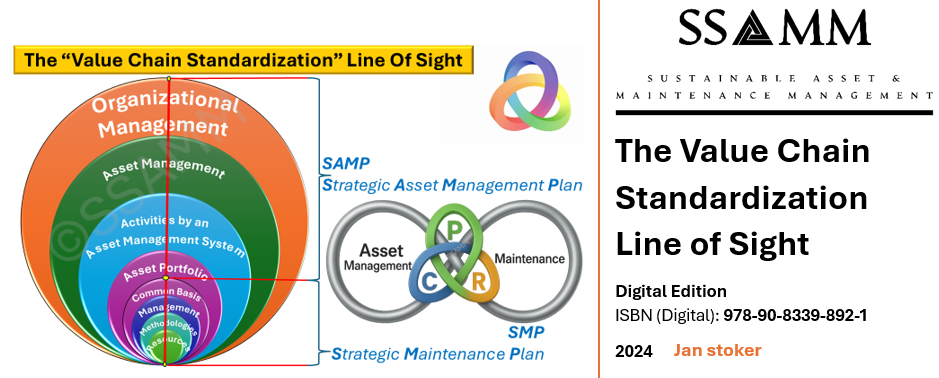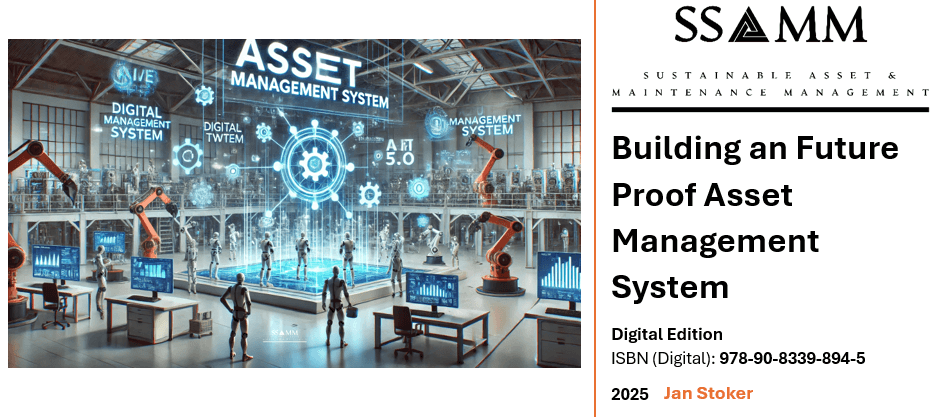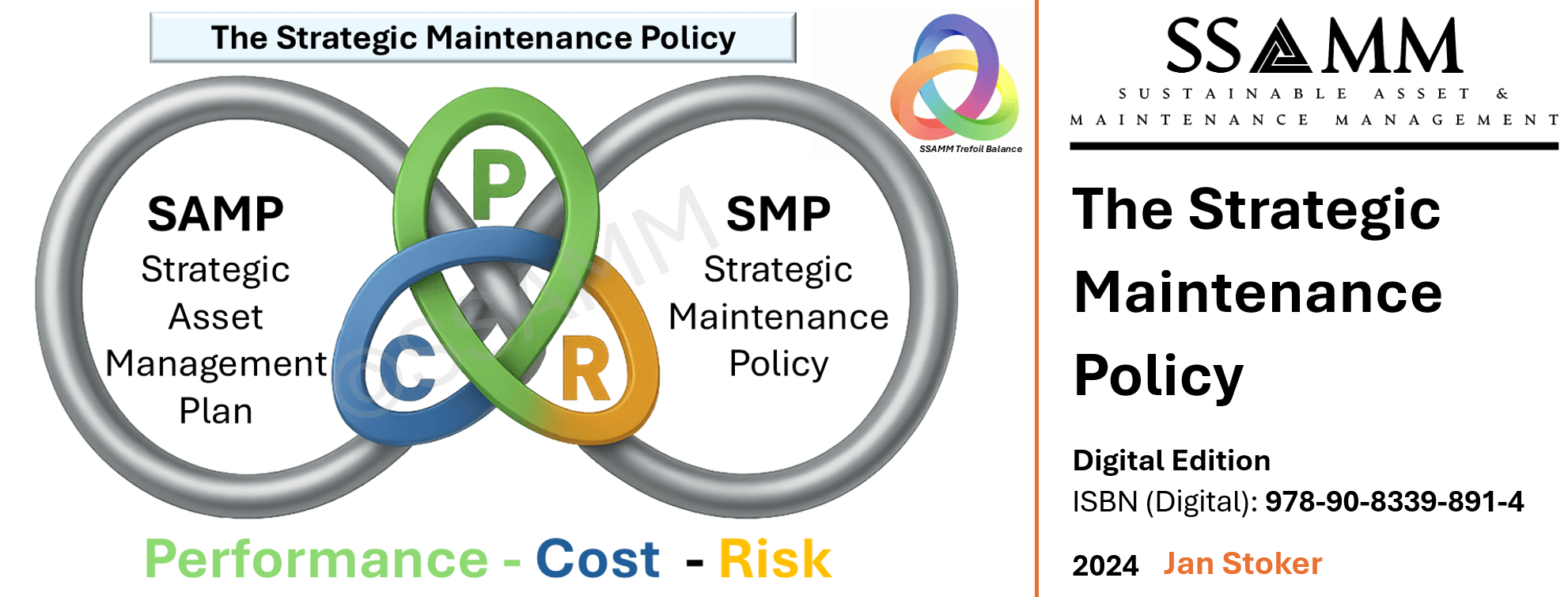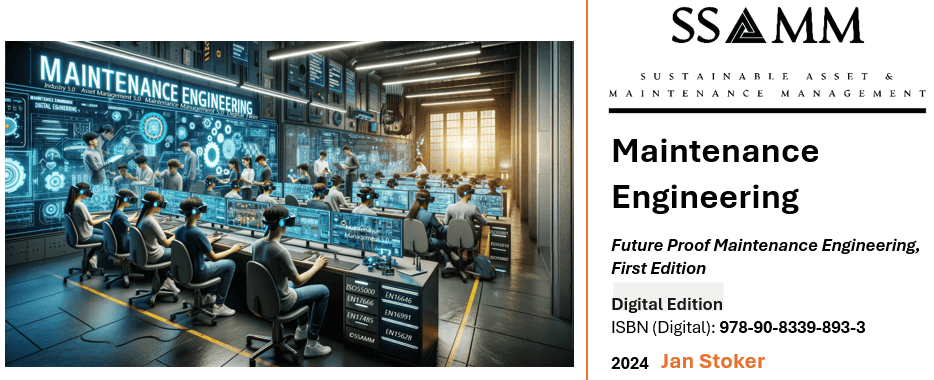
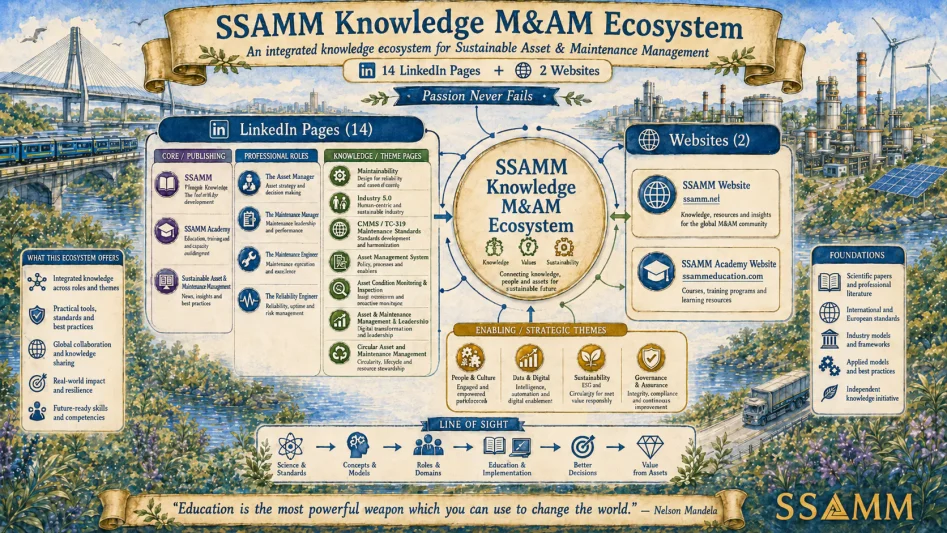
The SSAMM Knowledge M&AM Ecosystem brings together SSAMM, SSAMM Academy, two websites and a network of specialist LinkedIn pages into one integrated knowledge environment for Sustainable Asset & Maintenance Management. Each page has its own focus—covering professional roles, management systems, standards, engineering disciplines, lifecycle themes and implementation—while all remain connected through a shared Line of Sight from science and standards to competence, better decisions and sustainable value from assets.
The content is grounded, where relevant, in scientific literature, international and European standards, recognised bodies of knowledge and professional practice. Through articles, newsletters, events and purposeful visuals, the ecosystem aims to make complex knowledge more accessible and to inspire professionals and students to continue reading, questioning and learning.
Explore the pages that correspond with your professional role or interests and follow them for future publications and updates. A personal LinkedIn account is required to follow the LinkedIn pages, receive their posts in your feed and participate in professional discussions.
Knowledge should invite curiosity. Our motto: “Passion Never Fails.”
SSAMM is the organisational and professional home of the knowledge ecosystem.
The page connects advisory practice, applied research, standards-informed models, publications and strategic knowledge development in Asset & Maintenance Management. It also provides information about the wider development of SSAMM and its contribution to the professional field.
Open the SSAMM Academy LinkedIn page
SSAMM Academy is the education and competence-development page of the ecosystem.
It focuses on courses, professional learning pathways, recognised training dossiers, learning outcomes, assessment, competence development and the translation of standards and bodies of knowledge into structured education.
Sustainable Asset & Maintenance Management is the central editorial and community page of the ecosystem.
This is the principal page for integrated articles, newsletters, events, visual explanations and professional reflections. It connects the different roles, systems, standards and knowledge domains within Asset & Maintenance Management.
This page provides the broadest overview of the ecosystem and is therefore the recommended starting point for new followers.
Open the Asset Management System LinkedIn page
The Asset Management System page explores how organisations design, implement, operate, assure and continually improve an Asset Management System.
It connects organisational purpose and stakeholder needs with Asset Management objectives, decision criteria, policies, plans, processes, roles, information, lifecycle activities, performance evaluation and continual improvement.
An effective Asset Management System is not merely a collection of documents prepared for certification. It is the organisational management architecture through which people, processes, information, technology and lifecycle activities are aligned to realise value.
Open the Asset Manager LinkedIn page
The Asset Manager page focuses on the professional judgement, governance and decision-making required to realise value from assets.
Topics include stakeholder requirements, organisational objectives, Asset Management strategy, the Strategic Asset Management Plan, lifecycle planning, portfolio decisions, asset information and the balance between performance, cost, risk and opportunity.
The page also examines the interfaces between Asset Managers and executives, Finance, Engineering, Projects, Operations, Maintenance, Reliability and other stakeholders.
Open the Maintenance Manager LinkedIn page
The Maintenance Manager page focuses on the leadership, governance and professional practice of Maintenance Management.
Topics include maintenance policy, objectives and strategy; maintenance organisation; resources and competence; performance management; planning and control; budgets; contractors; materials; information; assurance; and continual improvement.
The page positions Maintenance as a strategic, managerial and technical function rather than merely the execution of work after decisions have already been made.
Open the Maintenance Engineer LinkedIn page
The Maintenance Engineer page focuses on the engineering decisions, methods and evidence required to make maintenance effective, efficient and lifecycle-oriented.
Topics include maintenance requirements during design and modification, maintenance concepts, task development, failure and degradation analysis, condition-based maintenance, maintenance support, documentation, spares, data analysis and technical improvement.
The page also clarifies the interfaces between Maintenance Engineering, Reliability Engineering, Maintainability, Operations, Projects and Asset Management.
Open the Reliability Engineer LinkedIn page
The Reliability Engineer page focuses on understanding, predicting and managing how and why assets and systems fail to fulfil their required functions.
Topics include operational context, required functions, functional failures, failure modes, failure mechanisms, failure effects and consequences, RCM, FMEA and FMECA, root-cause analysis, reliability modelling, field data, condition monitoring and failure-management policies.
The objective is not simply to reduce the number of failures. It is to support defensible decisions concerning function, consequence, risk, performance and value.
Open the Maintainability LinkedIn page
The Maintainability page focuses on designing and assuring the conditions under which assets can be retained in, or restored to, their required state safely, effectively and efficiently.
Topics include maintainability requirements, design for maintenance, accessibility, modularity, standardisation, testability, diagnostics, human factors, maintenance task analysis, supportability, documentation, spares, verification and lifecycle feedback.
Good Maintainability is created before maintenance begins.
Open the Industry 5.0 LinkedIn page
The Industry 5.0 page explores the human-centric, sustainable and resilient development of industry and its implications for Asset & Maintenance Management.
It examines the relationships between people, physical assets, digital technologies and organisational purpose. Topics include human-in-the-loop systems, artificial intelligence, data, digital twins, robotics, competence, resilience, circularity, governance, ethics and responsible digital transformation.
Technology is treated as an enabling capability—not as a replacement for context, professional judgement or accountable decision-making.
Open the Life Cycle Management LinkedIn page
The Life Cycle Management page examines how Asset Management is applied throughout the life cycle of assets.
It connects decisions from need, requirements, concept and design through acquisition, commissioning, operation, maintenance, improvement, renewal, replacement, repurposing and end-of-life.
Life Cycle Management is not simply the chronological administration of lifecycle stages. It is the coordinated application of Asset Management across those stages to create, realise and sustain value for stakeholders.
Open the CEN/TC319 Maintenance Standards LinkedIn page
The CEN/TC 319 Maintenance Standards page is dedicated to understanding the coherent European framework of Maintenance Standards.
The standards are approached as an interconnected architecture consisting of:
- a common basis for terminology and processes;
- a management layer for governance and lifecycle direction;
- methodologies for engineering, analysis and performance improvement; and
- resources for competence, contracts, documentation and support.
The page explains how these standards help position Maintenance within the broader Asset Management System.
Our sources




SSAMM Publications